
Turn on a basic heater, and the temperature overshoots. Turn it off, and the temperature drops below the setpoint. This oscillation is the fundamental problem that PID controllers solve. Proportional-Integral-Derivative control is the algorithm behind precise temperature regulation in everything from industrial ovens to grill controllers to laboratory equipment.
The Problem with On/Off Control
Simple on/off control (also called bang-bang control) switches the heating element fully on when the temperature is below setpoint and fully off when it is above. This approach is cheap and simple, but it produces significant temperature oscillation. The thermal mass of the system and the lag between heater activation and temperature change at the sensor mean the temperature constantly hunts above and below the target.
For many applications, this oscillation is unacceptable. Soldering profiles require precise temperature ramps within a few degrees. Food safety depends on maintaining exact holding temperatures. Industrial processes need consistent thermal conditions for quality and repeatability.
How PID Control Works
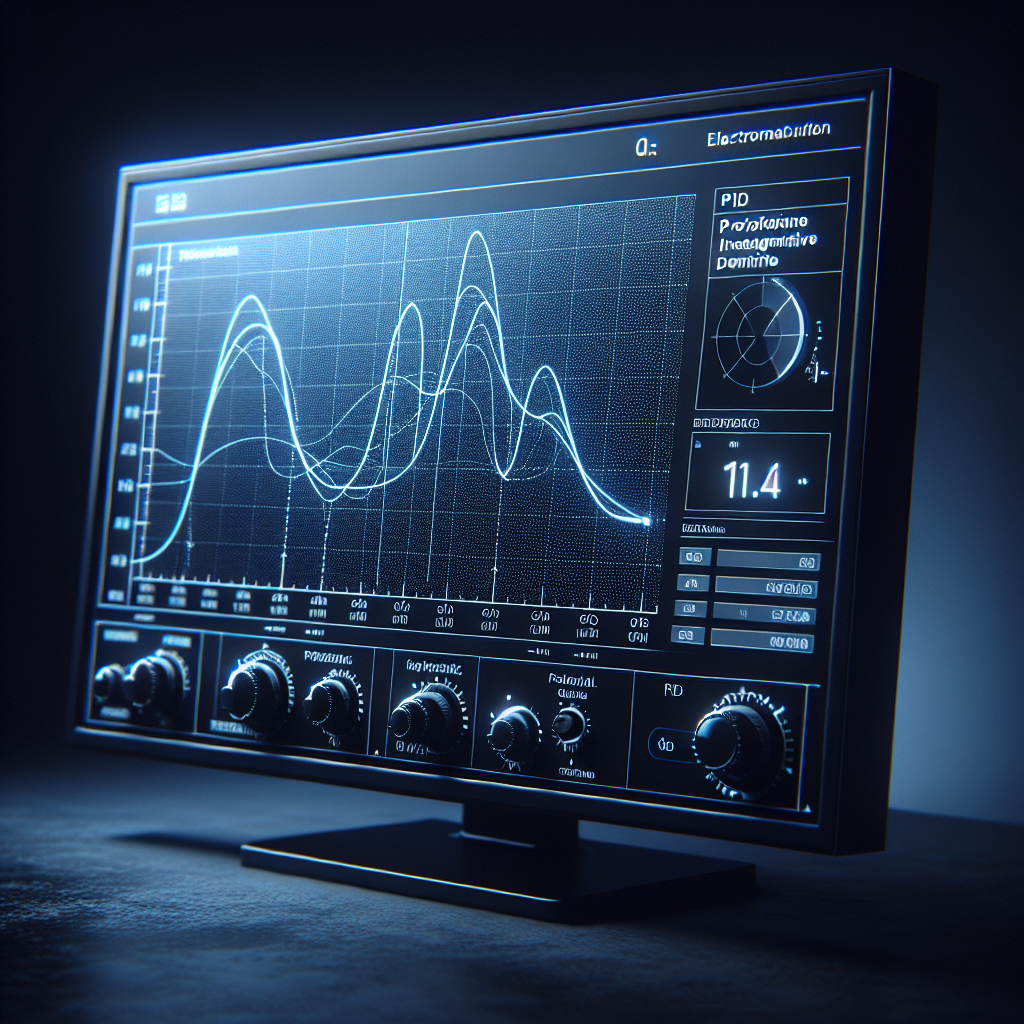
A PID controller continuously calculates an error value — the difference between the desired setpoint and the measured temperature — and applies a correction based on three terms that each address a different aspect of the control problem.
Proportional (P)
The proportional term responds to the current error. If the temperature is 10 degrees below setpoint, the controller applies a proportional amount of heating power. Larger errors produce larger corrections. The proportional gain (Kp) determines how aggressively the controller responds. Too much gain causes oscillation; too little gives sluggish response.
Proportional control alone always leaves a steady-state error — the controller needs some error to produce output, so the temperature never quite reaches the setpoint. This residual error is called droop or offset.
Integral (I)
The integral term accumulates error over time. Even a small persistent error between the temperature and setpoint builds up in the integral term, producing an increasing correction until the offset is eliminated. The integral gain (Ki) controls how quickly this accumulation drives the output.
Integral action eliminates steady-state error but introduces its own challenge: integral windup. If the system cannot reach setpoint (perhaps the heater is undersized for the load), the integral term accumulates indefinitely, causing massive overshoot when conditions change. Practical controllers include anti-windup mechanisms to limit integral accumulation.
Derivative (D)
The derivative term responds to the rate of change of the error. If the temperature is approaching the setpoint rapidly, the derivative term reduces the output to prevent overshoot. It acts as a damper, smoothing the response and reducing oscillation. The derivative gain (Kd) sets the sensitivity to rate changes.
Derivative action improves transient response but amplifies noise in the measurement signal. High-frequency sensor noise produces large derivative spikes that disrupt control. Practical implementations include a low-pass filter on the derivative term to attenuate noise.
Tuning a PID Controller
The performance of a PID controller depends entirely on the three gain parameters (Kp, Ki, Kd) being matched to the characteristics of the specific thermal system. A set of gains that works perfectly for one oven will cause oscillation or sluggish response in another.
Several tuning methods exist. The Ziegler-Nichols method systematically increases proportional gain until the system oscillates, then calculates all three gains from the oscillation characteristics. Auto-tune algorithms built into modern controllers automate this process by applying test perturbations and analyzing the system response.
Manual tuning by an experienced engineer remains common for critical applications. Start with proportional-only control, increase gain until acceptable response speed with moderate overshoot, then add integral action to eliminate steady-state error, and finally add derivative action to reduce overshoot.
PID in Custom Electronics
Implementing PID control in a custom electronic product requires more than the algorithm itself. Accurate temperature measurement with appropriate sensor selection and signal conditioning is essential — a noisy temperature reading makes good control impossible. The output stage must provide proportional control, not just on/off switching. PWM-driven solid-state relays or SCR phase-angle controllers provide the variable output a PID algorithm needs.
At Roanoke Electronic Controls, we have designed custom PID-based temperature controllers for applications ranging from commercial grills to industrial process equipment. Our embedded firmware team implements optimized PID algorithms with auto-tune capability, and our hardware designs provide the precise sensing and output control the algorithms require. Contact us to discuss your temperature control application.
Ready to Build Your Custom Electronics?
From concept to production, Roanoke Electronic Controls delivers complete custom electronics manufacturing solutions.
Request a Quote