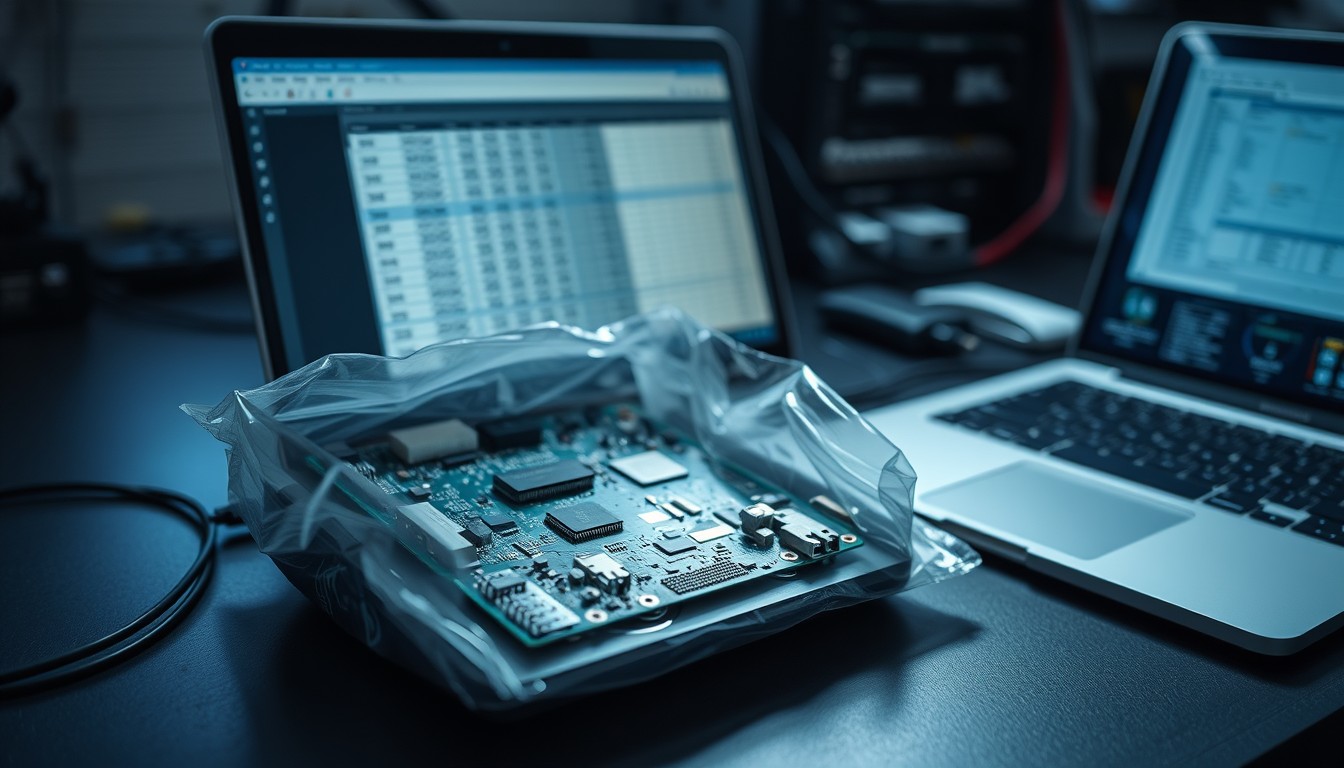
JLCPCB has made assembled prototypes cheap and fast, and a lot of the designs that reach us now started there. That is a good way to start. But a design set up for JLC's assembly service carries assumptions that only hold at JLC, and before another factory can build it in production, a few things need translating. Our post on taking a prototype to volume production covers the general gap between a working prototype and a product. This is the JLC-specific list.
Can a US manufacturer use my JLCPCB files as they are?
The Gerbers, yes. The bill of materials and the placement file, usually not. Both are written for JLC's parts library and JLC's machines, and they leave out information any other factory needs. Fixing them takes an afternoon before you ask for a quote, or a week of questions after.
What is wrong with LCSC part numbers on my BOM?
JLC builds from the LCSC catalog, so a BOM exported for JLC often identifies each part only by its LCSC number, the ones that start with C. Outside JLC that number means nothing to a purchasing system. Add the manufacturer and the manufacturer part number to every line. LCSC's product page for each part lists both, so that is the place to start. Keep the LCSC number in its own column if it helps you; just do not make it the only identifier.
What about parts only LCSC sells?
JLC's basic parts library rewards designers for choosing parts that are already loaded on its machines, and extended parts cost extra to set up. That is a sensible incentive for prototypes, but many basic parts come from manufacturers with little or no distribution in the US. For a production board you want parts you can buy from more than one authorized source, this year and in five years. Expect to replace a few: regulators, MOSFETs, LEDs, connectors and passives from brands US distributors do not carry. Each replacement is a datasheet and footprint check, and occasionally a layout change. Find them before the quote, not after the first order.

Why would my parts come out rotated somewhere else?
Because CAD libraries, JLC and other factories do not always agree on a part's zero orientation. The plugins that export JLC placement files often apply JLC-specific rotation corrections, so a file that builds perfectly at JLC can put SOT-23 transistors, diodes or ICs 90 or 180 degrees off on another line. Export a clean placement file straight from your CAD tool, without the JLC corrections, and send an assembly drawing that shows polarity. The manufacturer checks rotation against the drawing, and the first article catches anything that slips through.
What happens to the panel JLC made?
If you let JLC panelize the board, the rails, breakaway tabs, fiducials and tooling holes may exist only in JLC's job, not in your files. A production manufacturer panelizes for its own line: rail widths that fit its conveyor, fiducials where its machines expect them, and a breakaway method that will not crack parts near the edge. Send single-board Gerbers and let the manufacturer design the panel, or send your panel and ask for feedback on it in the manufacturability review.
Does anything else change?
- Test. At JLC you most likely tested a board by using it. In production every board needs a fast, repeatable test, which means test points the probes can reach. If your prototype has none, now is the cheap time to add them.
- Through-hole parts. Prototype through-hole parts are often hand-soldered. In production they go through wave or selective soldering, which needs enough space around them and the right orientation relative to the wave.
- Revision control. A production run needs one agreed set of files: board revision, BOM revision and firmware version, all matching.

Should I move production away from JLC at all?
For prototypes, keep using them. Nobody beats the big online board houses on speed and price for a five-piece run. Production is a different question: landed cost with tariffs and freight, lead time, the ability to talk to the engineer building your board, and the ability to walk the floor where it is built. We wrote up how to compare the two honestly in moving PCB assembly to the US.
What should I send REC?
- Gerbers for the single board
- A BOM with manufacturer and manufacturer part number on every line, LCSC numbers optional in their own column
- A clean placement file and an assembly drawing
- A working JLC prototype, if you can spare one
- How you test it today, even if that is "plug it in and see if the light comes on"
- The quantities you want priced and your expected annual volume
Our engineers review the BOM as part of the quote and flag any part without a dependable US source, with a suggested replacement for you to approve. We do not substitute anything without your approval. The quote and the manufacturability review come back within one business day. See how a production job runs at REC, or request a production quote.


Ready to Build Your Custom Electronics?
From concept to production, Roanoke Electronic Controls delivers complete custom electronics manufacturing solutions.
Request a Quote